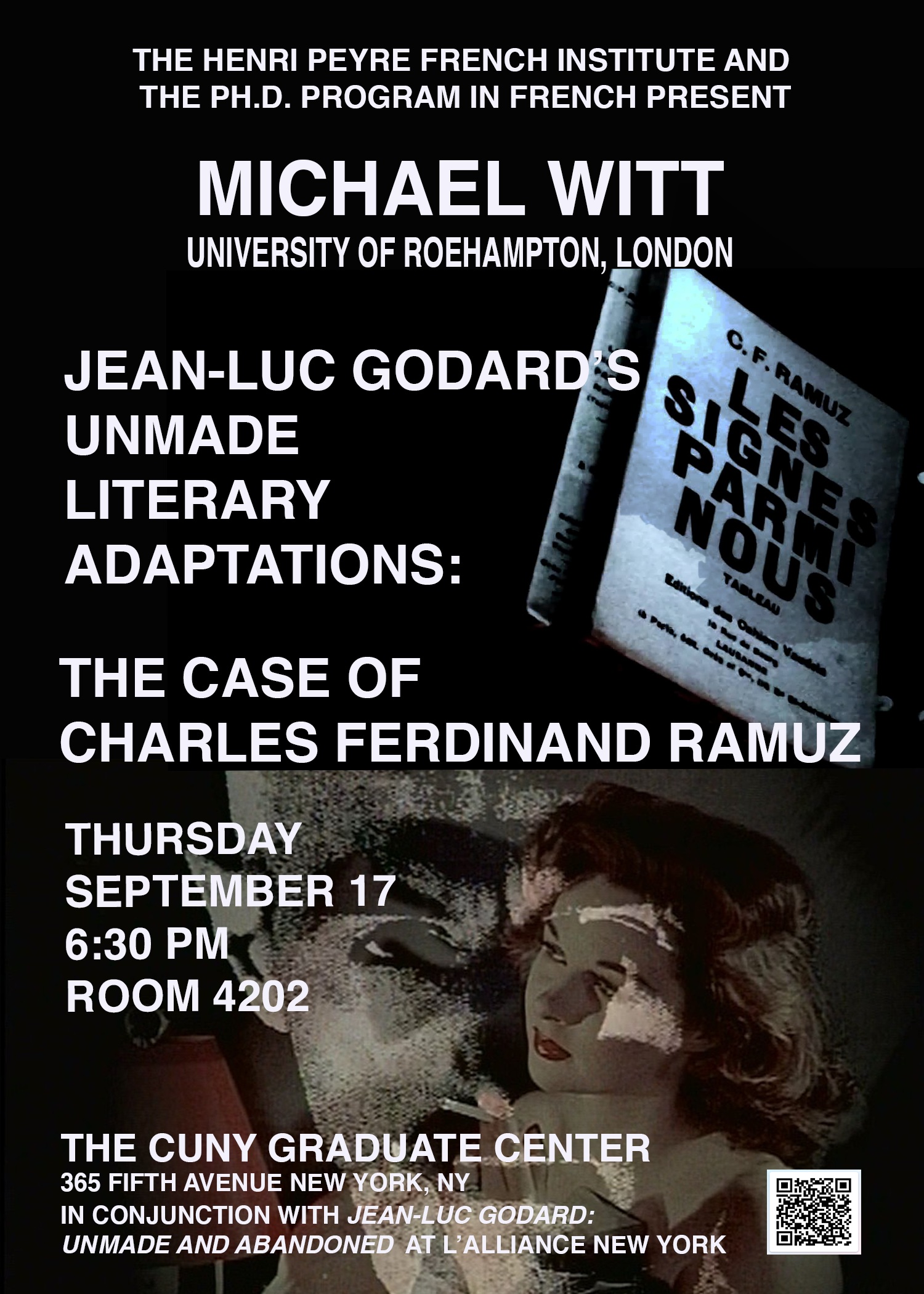
Jean-Luc Godard’s oeuvre is deeply literary in the sense of being steeped in, informed by and in dialogue with literature. A voracious reader as a child and adolescent, his initial aspiration was to become a novelist. The numerous completed literary adaptations that pepper his filmography are accompanied by a voluminous shadow corpus made up of unrealised or abandoned adaptation projects, which range from classics to genre fiction, memoirs and contemporary literature. In this parallel ‘non-corpus’, one author stands out due to the number of times that Godard sought to adapt his books over a long period of time: the Swiss Charles-Ferdinand Ramuz.
Three of Godard’s earliest adaptation projects, for which he wrote scripts in the late 1940s and early 1950s, were from works by Ramuz: Aline (1905), Jean-Luc persécuté (Jean-Luc Persecuted, 1909) and Les Signes parmi nous (The Signs Among Us, 1919). These ambitious youthful ventures were followed in 1962, once he had established a name for himself, with plans for a film based on Ramuz and Igor Stravinsky’s musical play, Histoire du soldat (The Soldier’s Tale, 1918). Two decades later, he sought to adapt Ramuz’s La Beauté sur la terre (Beauty on Earth, 1927), and in 1990 he returned to his quest to make a film derived from Ramuz’s tale of the activities of a pedlar of religious pamphlets towards the end of World War I, Les Signes parmi nous. In his quirky treatment for this planned contemporary version of Ramuz’s fable, the pedlar has been replaced by a filmmaker with a striking resemblance to Godard himself. In the end, the only Ramuz adaptation that Godard completed was the stunning short video essay he co-directed with Anne-Marie Miéville in 2002, Liberté et patrie (Freedom and Fatherland), which was loosely based on Ramuz’s autobiographical Aimé Pache, peintre vaudois (Aimé Pache, Vaudois Painter, 1910).
In this illustrated talk, Michael Witt will examine Godard’s long relationship with Ramuz, his unmade Ramuz adaptation projects, and the traces of these in his completed works, including in his audiovisual history of cinema, Histoire(s) du cinéma (1988-1998), the final chapter of which is titled Les Signes parmi nous and contains a key sequence inspired by Ramuz’s eponymous work.
Michael Witt is Professor of Cinema at the University of Roehampton, London. He is the author of Jean-Luc Godard’s Unmade and Abandoned Projects (Bloomsbury, 2025), Notre musique, c’est celle de tout le monde: Entretien avec Jean-Luc Godard (202 éditions, 2024), and Jean-Luc Godard, Cinema Historian (Indiana University Press, 2013). He is also the co-editor of For Ever Godard (Black Dog Publishing, 2004), Jean-Luc Godard: Documents (Éditions du Centre Pompidou, 2006), and The French Cinema Book (2nd edition BFI/Bloomsbury, 2018); and the translator of Jean-Luc Godard, Scénario: Les Cinq Cahiers de Jean-Luc Godard (Le Livre d’Images Éditions, 2025).